
Spaced repetition
Overview
HanziHero uses a spaced repetition system (SRS) to schedule reviews of the items you learn. Instead of reviewing every item equally often, you revisit each one at intervals that change based on the accuracy of your answers. Correct answers generally lead to longer intervals, while incorrect answers bring an item back sooner for more practice.
After you complete an item's initial practice, its first review is due one day later. Each item has its own review schedule and SRS stage, so your progress with one item does not determine when another is due. As you continue to recall an item successfully, its reviews become less frequent. Items that reach Master no longer have scheduled reviews.
Reviews take place within Study, alongside your lessons. This page explains how review intervals and SRS stages work; Lesson scheduling covers which new items appear in your lessons.
Review intervals
An item's review interval is the time between completing a review and when its next review becomes due. HanziHero calculates a new interval each time you finish reviewing the item, based on your answers, its previous interval, and its recent review history. Intervals are measured in whole days, with a minimum of one day.
Correct answers
Answering all of an item's questions correctly on the first attempt generally results in a longer interval before its next review. As you continue to remember it successfully, the time between reviews grows from days to weeks and eventually months.
For an on-time review, the next interval is usually about 1.8 times the previous interval—so a 10-day interval grows to roughly 18 days. Early reviews can grow faster: a one-day interval can increase to three or four days.
Incorrect answers
An incorrect answer generally results in a shorter interval before the next review, so you can practice the item again sooner. A mistake in either a reading or meaning question counts, even if you answer correctly on a later attempt.
If none of the item's previous five reviews contained a mistake, the next interval is roughly half the previous interval. Rounding and interval variation can change the exact result, and the interval never falls below one day.
Frequent mistakes
When you answer incorrectly, HanziHero also checks the item's previous five reviews. Each review in that history that contains at least one mistake halves the next interval again, giving items you repeatedly struggle with more frequent practice.
For example, if one of those five reviews contained a mistake, the next interval is roughly a quarter of the previous interval rather than half. If two contained mistakes, it is roughly an eighth.
When reviews become available
Your study day begins at 4 a.m. in your account's time zone. At that time, reviews scheduled for the new study day become available in Study.
Overdue reviews
An item is overdue when its scheduled review time has passed by at least one full day.
If you answer an overdue item correctly, the next interval can be longer than it would have been for an on-time review, because you remembered the item for longer. This adjustment is capped, so a long absence does not produce an unlimited increase.
Being overdue does not affect the interval adjustment if you answer incorrectly.
In either case, the next review is scheduled from when you complete the current review, not from its original due date.
Interval variation
HanziHero applies a small random adjustment to most review intervals. This means two items with similar review histories may have slightly different next review dates. The adjustment is measured in days and varies with the length of the interval.
The purpose of this variation is to better distribute the number of reviews you have each day.
SRS stages
An item's SRS stage summarizes its progress through the review schedule. The stage is determined by the interval calculated after its latest review, rather than by the number of reviews you have completed. Longer intervals correspond to higher stages.
A review can move an item up or down, or leave it at the same stage. Its interval can change without changing its stage, since most stages cover a range of intervals.
Stage groups
There are five stage groups: Novice, Apprentice, Journeyman, Expert, and Master. The first four contain numbered stages, such as Novice I and Novice II.
| Stage | Calculated review interval |
|---|---|
| Novice I | 1 day |
| Novice II | 2–4 days |
| Apprentice I | 5–8 days |
| Apprentice II | 9–16 days |
| Journeyman I | 17–32 days |
| Journeyman II | 33–64 days |
| Expert I | 65–128 days |
| Expert II | 129–256 days |
| Expert III | 257–380 days |
| Master | More than 380 days; scheduled reviews end |
These ranges describe the item's calculated interval, not how long it has been since you first learned it or how much time remains until its next review. An item's stage is updated after you complete all of its review questions in Study.
Reaching Master
An item reaches Master when a review produces an interval longer than 380 days. At that point, it will no longer appear in your scheduled reviews.
The item remains in your learned items, and you can still practice it through extra study.
Viewing your review progress
To see an item's review progress, open its detail page and scroll to Stats. This section appears once you have learned the item.
Current stage and next review
The Stats section shows:
- Current Stage: the item's current SRS stage.
- Last Reviewed: when you last completed a review of the item.
- Next Review: when the item is next scheduled for review.
The next review date tells you when the item becomes due, not when you must review it. If you review it later, its next interval starts from when you complete that review.
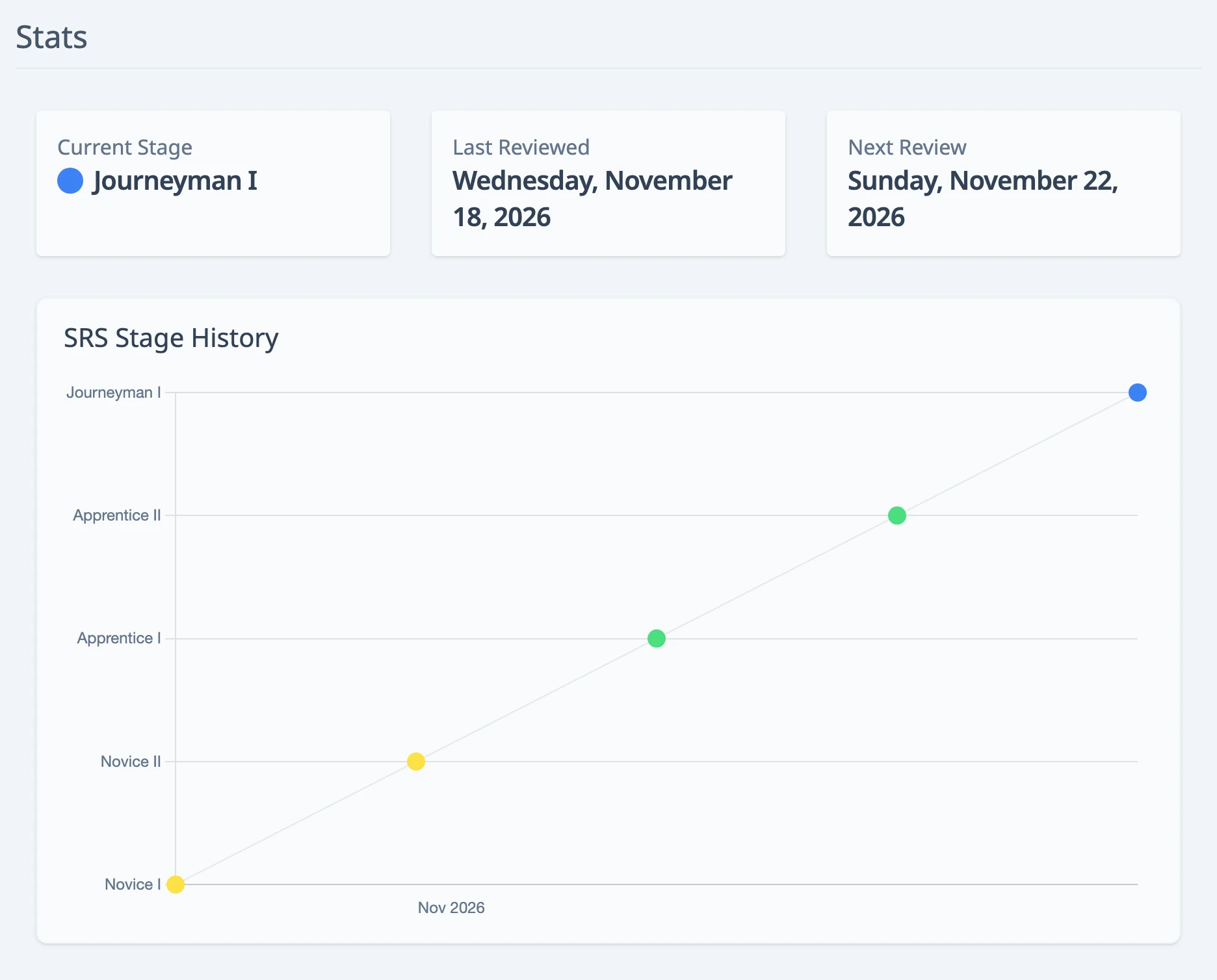
SRS stage history
The SRS Stage History chart shows how the item's stage has changed across its reviews. Rising stages reflect longer review intervals, while drops reflect shorter intervals after mistakes.
A flat stretch does not necessarily mean you are making no progress: an interval can grow while remaining within the same stage's range.
Extra study and review scheduling
Extra study lets you practice learned items without changing their review schedules. Neither correct nor incorrect answers affect an item's SRS stage or next review date, and the session does not add to its review history.
Practicing an item through extra study does not complete its scheduled review. If it is due, it remains due until you review it in a regular Study session. You can also use extra study to practice items that are not yet due or have reached Master.
See Starting extra study for ways to launch a practice session.